Trendjacking: riding a trend, and the short window that decides whether it works

By Tiago Costa·Updated on August 5, 2026

Definition
Trendjacking is riding a trend to carry your message.
- It borrows distribution the platform is already giving the format.
- The window is short, and arriving late costs more than staying out.
- It needs a real connection to what you do, or it is just noise.
- Different from newsjacking, which uses news and carries more risk.
What it is and why it works
A trend is anything that gained traction fast: an audio, a video format, a meme, a running joke, a subject of the moment. Trendjacking is using that wave as a vehicle for what you have to say.
The reason it works is practical. When a format is rising, the system already recognises the pattern and the audience already knows how to consume it. You spend no attention explaining the format, only on your message.
Worth separating from a close relative: newsjacking is the same manoeuvre with news instead of entertainment trends. It is more powerful and considerably riskier, because news usually involves real people and real consequences.
The window, which is the deciding factor
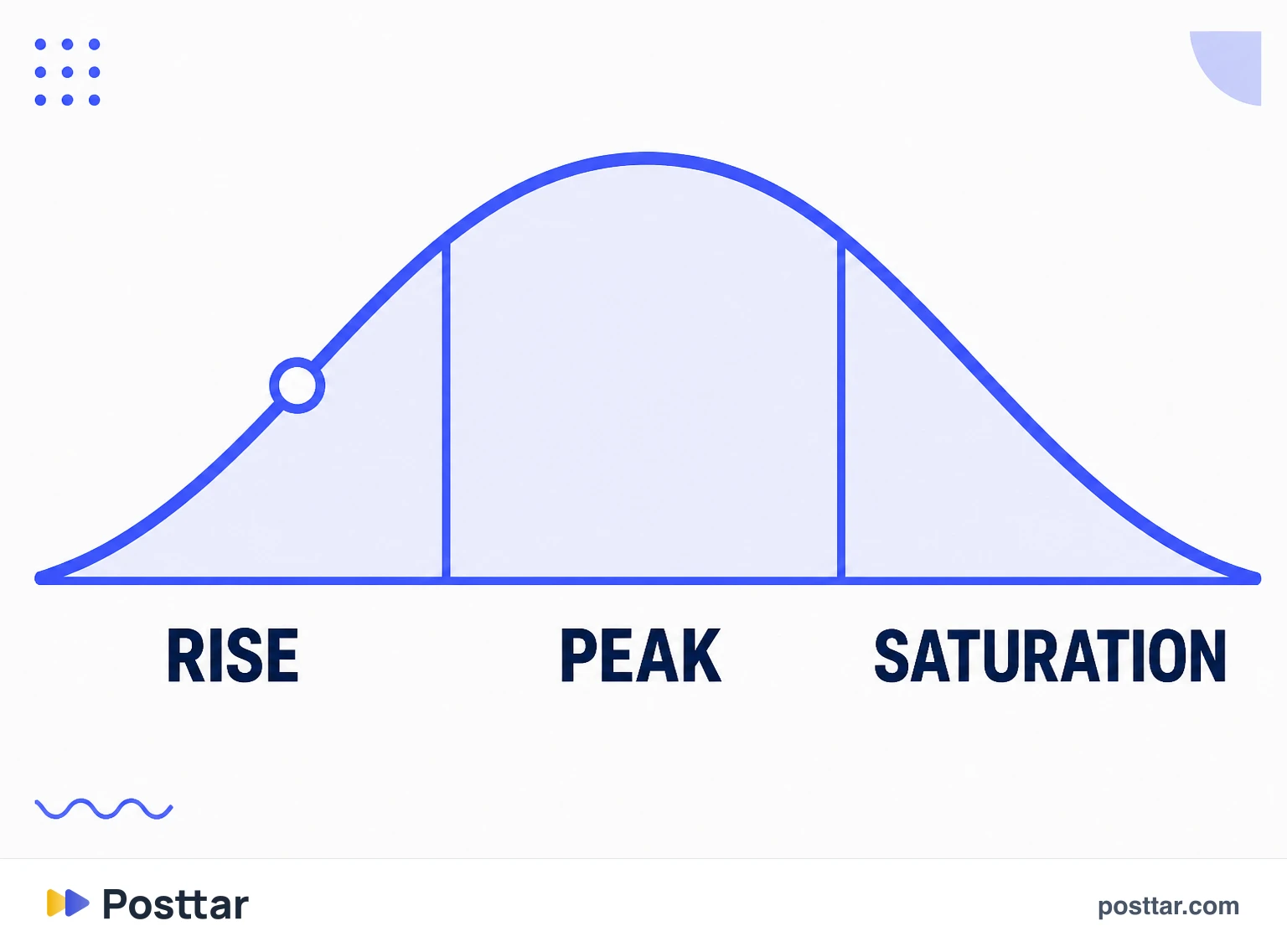
A trend has three phases, and the outcome changes completely depending on when you enter.
- The rise. Few people using it, generous distribution. Almost all the return sits here.
- The peak. Everyone doing it. Still works, but you compete with hundreds of identical versions.
- Saturation. The audience is already tired of it. Here the ride produces the opposite effect: it signals the account is behind.
The practical conclusion is uncomfortable for anyone needing internal approval: if the decision takes three days, do not enter. Arriving at saturation is worse than having stayed out, because it communicates slowness.
How to do it without embarrassment
- A real connection to what you do. The trend is the vehicle, your message is the cargo. With no cargo, it is just a copy.
- Adapt, do not reproduce. An identical reproduction does not differentiate and leaves no memory.
- Respect the original tone. Entering a joke with institutional language breaks both the format and the joke.
- Check the origin. Audios and formats sometimes come from a problematic context, and the ride brings the context with it.
- Know when not to enter. Not every trend is for every account, and staying out costs nothing.
When it gets expensive
The disasters follow a pattern, and they are almost always failures of reading rather than execution:
- Tragedy as opportunity. The simplest newsjacking rule: if there is a victim, no ride is possible.
- Identity or political topics with no track record. If the account never talked about it, joining the wave reads as opportunism, and the judgement is harsh.
- A trend that already turned into criticism. Sometimes what is rising is precisely the mockery of brands that jumped on.
- Forcing the connection. When the bridge between trend and product is too long, everyone sees the seam.
The quick test: if you have to explain why your brand is there, you should not be.
Checklist
- I am on the rise of the trend, not at saturation.
- There is a real connection to what I do.
- I adapted rather than reproducing it identically.
- I checked the origin of the audio or format.
- I do not need to explain why I am there.
Frequently asked questions
What does trend jacking mean?
It means riding a trend already in circulation to carry your own message. It works because the platform is already distributing that format or subject, so entering costs less attention than building something from scratch.
What is an example of trend jacking?
Using a rising audio to explain something from your niche, adapting the structure of the joke to your subject. The format delivers instant recognition, and your message rides in as content rather than the video being one more copy of the trend.
What is the difference between newsjacking and trendjacking?
Trendjacking uses entertainment trends such as audios, formats and memes. Newsjacking uses news. The second is more powerful and considerably riskier, because news usually involves real people and real consequences.
What is the trendjacking strategy?
Spot a trend on the rise rather than at its peak, find a genuine link to what you do, adapt the format instead of copying it, and publish fast. Speed is the whole strategy: the return sits in the rise, and it disappears at saturation.
When should you skip a trend?
When it has saturated, when it involves tragedy or victims, when the topic is identity or politics and your account never touched it, and when the bridge between the trend and what you do is so long that everyone sees the seam.
Related concepts

Going viral
Going viral is when a piece of content starts being distributed mainly by the people consuming it rather than by the platform's initial delivery. The mechanism is multiplication: each person reached brings in more than one new person. It is not luck or an algorithm trick, it is the result of a piece that gives viewers a strong reason to show it to someone else.
Read the entry
Explore page
The Explore page is Instagram's discovery grid, made almost entirely of content from accounts the person does not follow. It is assembled individually: there is no single version of Explore, each person sees a different grid built from their own interaction history. For publishers, landing on it is the fastest way to reach a new audience at scale.
Read the entry
Evergreen content
Evergreen content is what stays true and useful long after publishing, without depending on a date, on novelty or on the context of the moment. The name comes from trees that never lose their leaves. It returns less at the peak and far more cumulatively: while trend content delivers everything in 48 hours and dies, evergreen keeps being found, recommended and shared for months.
Read the entry
Reels
Reels is Instagram's short vertical video format, and the main distribution route to people who do not follow an account. Unlike a feed post, whose delivery depends heavily on the history between two accounts, a Reel is offered to whoever the system predicts is interested in the subject, which makes it the platform's most direct growth tool and also the most demanding on retention.
Read the entry