Instagram audience demographics: where to find them and what to do with them

By Tiago Costa·Updated on August 5, 2026
Definition
Audience demographics are the aggregate characteristics of the people following a profile.
- Includes age band, gender, city, country and activity hours.
- Professional accounts only, above a minimum base.
- Always aggregated. It never identifies anyone.
- Compare against who you reach, do not look only at the base.
What the panel provides
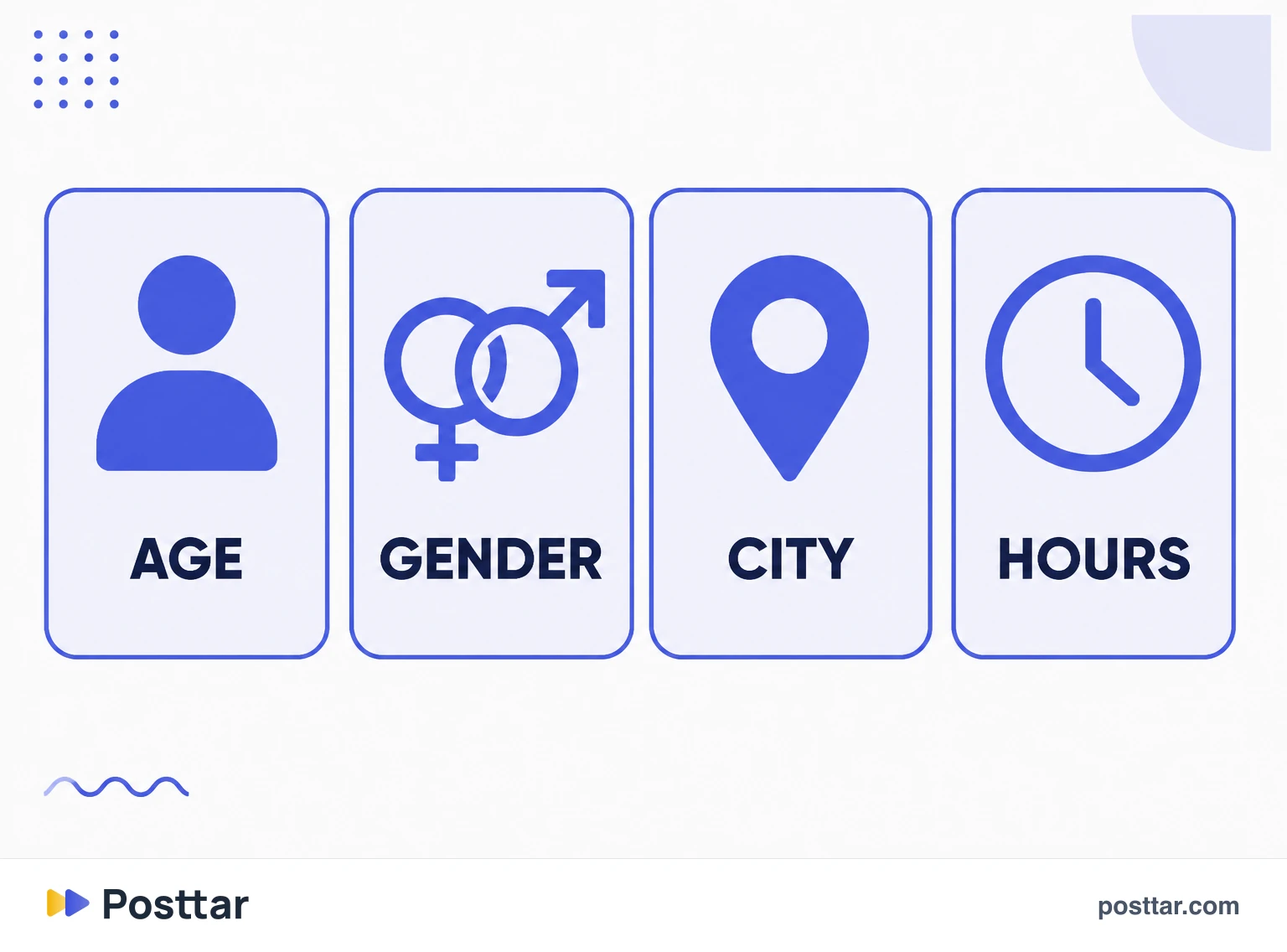
In the insights of a professional account, under audience, four cuts appear: age band, gender, top cities and countries and peak hours and days.
Two important restrictions. The first is that the data only appears above a minimum follower count, because below that the platform does not consider the aggregate anonymous enough. The second is that everything is aggregate: there is no way to know the age of a specific follower, and no legitimate tool provides that.
Also worth remembering that gender and age come from what people declared at signup, so they are an approximation rather than a census.
The reading almost nobody does
Looking at base demographics alone is the easy part and the least useful. The question that changes decisions is different: does who I reach look like who follows me?
If the base is mostly one age band and non follower reach comes from another, your discovery content is attracting a different audience from the one you built. That can be excellent, if it is where you want to go, or terrible, if it is noise that will become an unfollow next month.
The same comparison holds for cities. A profile selling in person while reaching mostly another region has a distribution problem, not a content problem.
Peak hours and the myth they became
The panel shows which hours and days your base uses the app most, and that fuelled years of content about "the best time to post".
The data is real and the conclusion was overstated. With delivery depending increasingly on recommendation, timing matters less than it used to, and a piece keeps being distributed for days. What timing still solves is the first window: publishing while your base is awake gives more chance of early signal, and early signal influences the next delivery.
Treated that way, the data is useful. Treated as a formula, it becomes superstition.
How to actually use it
- Check whether the base is who you want. If you sell to one audience and the base is another, the problem is topics, not offer.
- Compare base against non follower reach. That is where the direction the account is heading shows up.
- Use city data to choose format and references. A local example only works if the audience is local.
- Use timing for the first window, not as sacred law.
- Do not chase niche averages. The useful demographic is yours.
Checklist
- I look at base demographics and reach demographics, not just the first.
- I remember age and gender are declared, not verified.
- I use timing as a starting window, not a formula.
- I do not look for individual data: it does not exist.
- I review demographics after a viral, to see whether the base shifted.
Frequently asked questions
How do I see audience demographics on Instagram?
In the insights of a professional account, under audience. You get age band, gender, top cities and countries, and peak activity hours. Personal accounts have no access to that data.
Why are my audience demographics not showing?
Because the profile is not professional yet, or because the base is too small. Instagram only shows the breakdown above a minimum follower count, so the aggregate cannot be used to identify individuals.
Can I see the age of a specific follower?
No. All demographic data is aggregate and anonymous. There is no legitimate way to find the age, gender or city of an individual follower through insights or an external tool.
Are follower demographics the same as viewer demographics?
Not always, and the difference is the most useful information in the panel. If non follower reach comes from a different band than your base, your discovery content is attracting another audience, which can be good or bad depending on where you want to go.
What demographics use Instagram the most?
Platform-wide figures change every year and vary by country, so they are a poor guide for an individual profile. What matters for your decisions is your own base and, above all, the audience your content is reaching beyond it.
Related concepts
Followers
Followers are the accounts subscribed to a profile. For years the number was treated as a synonym for reach, but with delivery now depending on recommendation rather than only on who you follow, the base became something more modest and more important at once: it does not guarantee anyone sees the content, and it remains the only audience you can reach without depending entirely on the algorithm.
Read the entry
Reach
Reach is the number of unique accounts that saw a piece of content at least once. Unlike impressions, it does not count the same person twice, so it measures the size of the audience touched rather than the volume of exposure. On Instagram, reach is reported per post and per period, and it can be split between followers and non followers, which is the reading that shows whether a profile is discovering new people or simply circulating among those who already follow it.
Read the entry
Best time to post
The best time to post is when your specific audience is most active, and it is not the same as the chart circulating online. Timing affects initial delivery, which is the first test any post faces, but it does not decide final performance: good content posted at a bad hour still works, and bad content posted at the perfect hour is still bad.
Read the entry
Accounts reached
Accounts reached is the number of distinct accounts that saw any content from your profile in the selected period. It is the same idea as reach, applied to the whole profile instead of a single post: each person counts once, even if they saw ten posts, a Story and a Reel. That is why the number is never the sum of your posts' reach, and is always lower than it.
Read the entry