Engagement rate by reach: the metric that judges content, not size

By Tiago Costa·Updated on August 5, 2026
Definition
Engagement rate by reach is the percentage of people who saw the content and reacted to it.
- Formula: interactions divided by reach, times 100.
- It judges the piece, because it only counts people who had the chance to interact.
- It does not punish growth, unlike the follower-based rate.
- Only calculable from inside, with access to insights.
Why divide by reach instead of followers
The two engagement rate formulas answer different questions, and the choice of denominator is the entire decision.
Dividing by follower count measures how the base you built responds. It is useful, but it carries a known bias: the bigger the account, the larger the share of inactive people in the denominator, and the lower the rate, even with equal or better content.
Dividing by reach fixes that. Whoever did not see it leaves the calculation. If a post reached 2,000 accounts and got 200 interactions, 10% of the people who saw it reacted, and that is information about the piece, not about the size of the profile. Which is why this is the right formula for deciding what to produce more of.
How to calculate it
Rate by reach = (likes + comments + saves + shares) ÷ reach × 100
Two decisions have to be explicit before calculating:
- What counts as an interaction. The full reading adds all four. Adding only likes and comments underestimates exactly what matters most.
- Which reach. The post's, over the same time window as the interactions. Mixing 24-hour reach with a week of accumulated interactions inflates the ratio.
Instagram does not hand this rate over. It gives the raw numbers in insights and the calculation is left to whoever is analysing, or to a tool.
When to use each formula
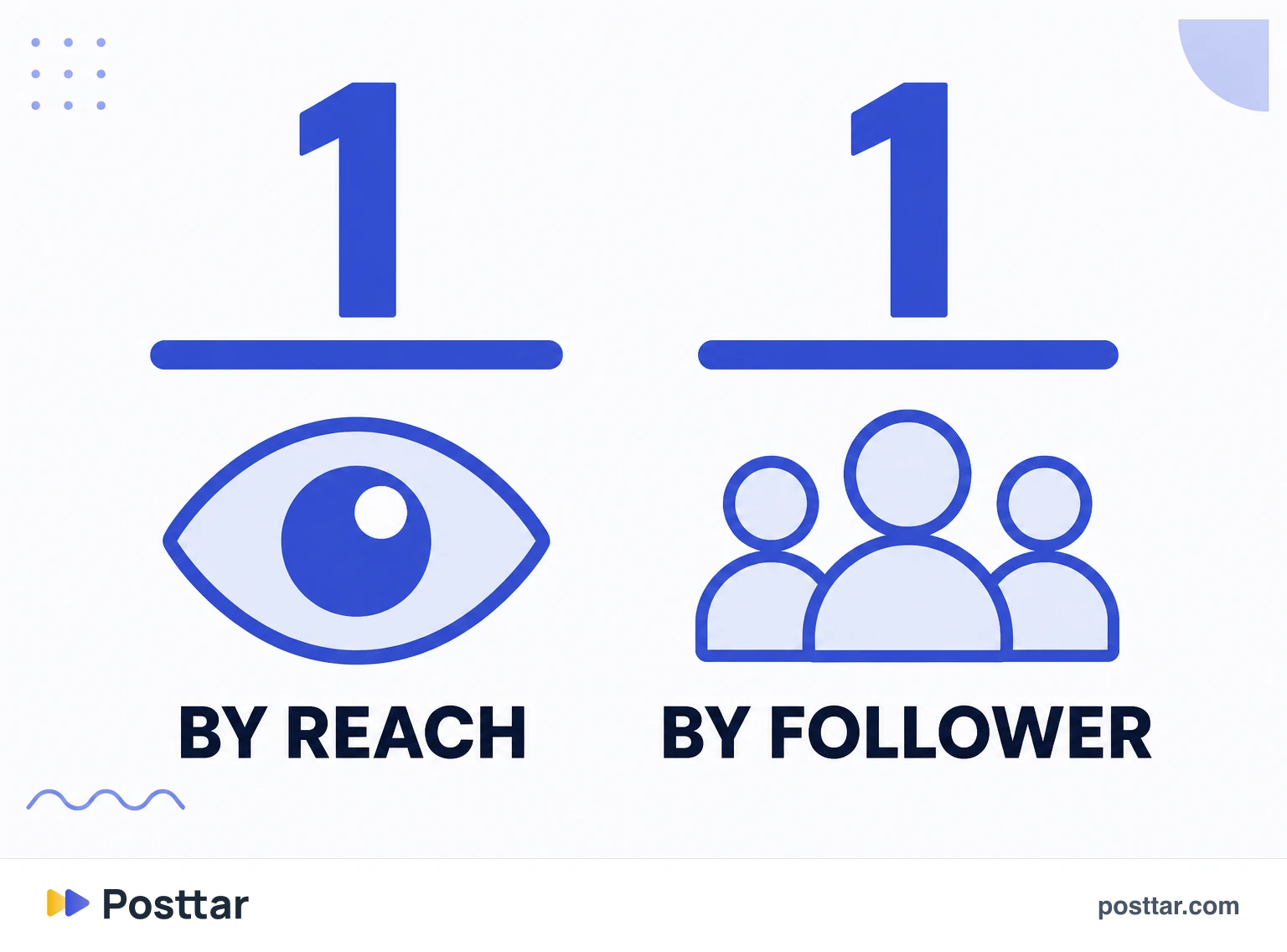
| Decision | Formula | Why |
|---|---|---|
| What content to produce more of | by reach | isolates the quality of the piece |
| Profile health over time | by follower | captures a base that grew without engaging |
| Negotiating sponsorship or comparing profiles | by follower | the only one computable from outside |
The expensive mistake is mixing them. Comparing your reach-based rate against a market benchmark measured by follower produces a wrong conclusion wearing the costume of data, and almost always an over-optimistic one, because the reach-based rate usually yields a bigger number.
What this rate reveals that the other hides
- Content delivered to the wrong audience. An off-niche viral has high reach and a low reach-based rate. The follower-based rate does not expose that.
- Real quality on a large account. Big profiles with a low follower-based rate can have an excellent reach-based rate.
- Formats that hold attention. Carousels and Reels usually show a higher reach-based rate than a single photo, because they ask for time.
- The effect of an inflated base. Fake followers do not affect this formula, since they are not in the reach.
Checklist
- I state which formula I am using before comparing any number.
- I add all four interactions.
- I use reach and interactions from the same time window.
- I do not compare this rate against market benchmarks measured by follower.
- I use the median of the last thirty of the same format as a baseline.
Frequently asked questions
How do you calculate engagement rate by reach?
Add likes, comments, saves and shares, divide by the post's reach and multiply by 100. Use interactions and reach from the same time window, otherwise the denominator is misaligned.
Is a 20% engagement rate good?
By reach, 20% is quite high and usually appears on very specific niche posts or small accounts with a strong community. By follower, 20% would be exceptional. Since the two formulas produce different numbers, the percentage only means something when you say which one you used.
What is the difference between reach and engagement?
Reach is how many distinct people saw the content. Engagement is how many interacted. The engagement rate by reach is the ratio between the two, meaning the percentage of viewers who reacted.
What is considered a good reach-based rate?
There is no universal number, because it varies with account size, niche and format. The reliable benchmark is the median of your last thirty pieces of the same format, always calculated with the same formula.
Why is the reach-based rate higher than the follower-based one?
Because the denominator is smaller. A post's reach is almost always a fraction of total followers, so dividing by reach yields a bigger percentage. It is another reason never to compare the two against each other.
Related concepts

Engagement rate
Engagement rate is the percentage of people who interacted with a piece of content relative to a comparison base. Two formulas are in common use: interactions divided by followers, which measures how the base responds, and interactions divided by reach, which measures the quality of delivery. They answer different questions and produce different numbers for the same post, so the thing that matters is stating which one you used before comparing anything.
Read the entry
Engagement
Engagement is the set of interactions people have with a piece of content: likes, comments, saves and shares, plus Story replies and mentions. It is an absolute count, not a percentage, which is why it only makes sense against a base, either reach or follower count. The four interactions are not equal: the ones that cost the viewer more effort are the ones that push distribution hardest.
Read the entry
Reach
Reach is the number of unique accounts that saw a piece of content at least once. Unlike impressions, it does not count the same person twice, so it measures the size of the audience touched rather than the volume of exposure. On Instagram, reach is reported per post and per period, and it can be split between followers and non followers, which is the reading that shows whether a profile is discovering new people or simply circulating among those who already follow it.
Read the entry
Reach rate
Reach rate is the percentage of your follower base that actually saw a piece of content, calculated by dividing reach by follower count. It exists because absolute reach is not comparable across accounts or across moments: a thousand accounts reached is excellent for a profile with two thousand followers and poor for one with two hundred thousand. It turns reach into an efficiency metric instead of a size metric.
Read the entry