Frequency: how many times each person saw your content

By Tiago Costa·Updated on August 5, 2026
Definition
Frequency is the average number of times each person reached saw the content.
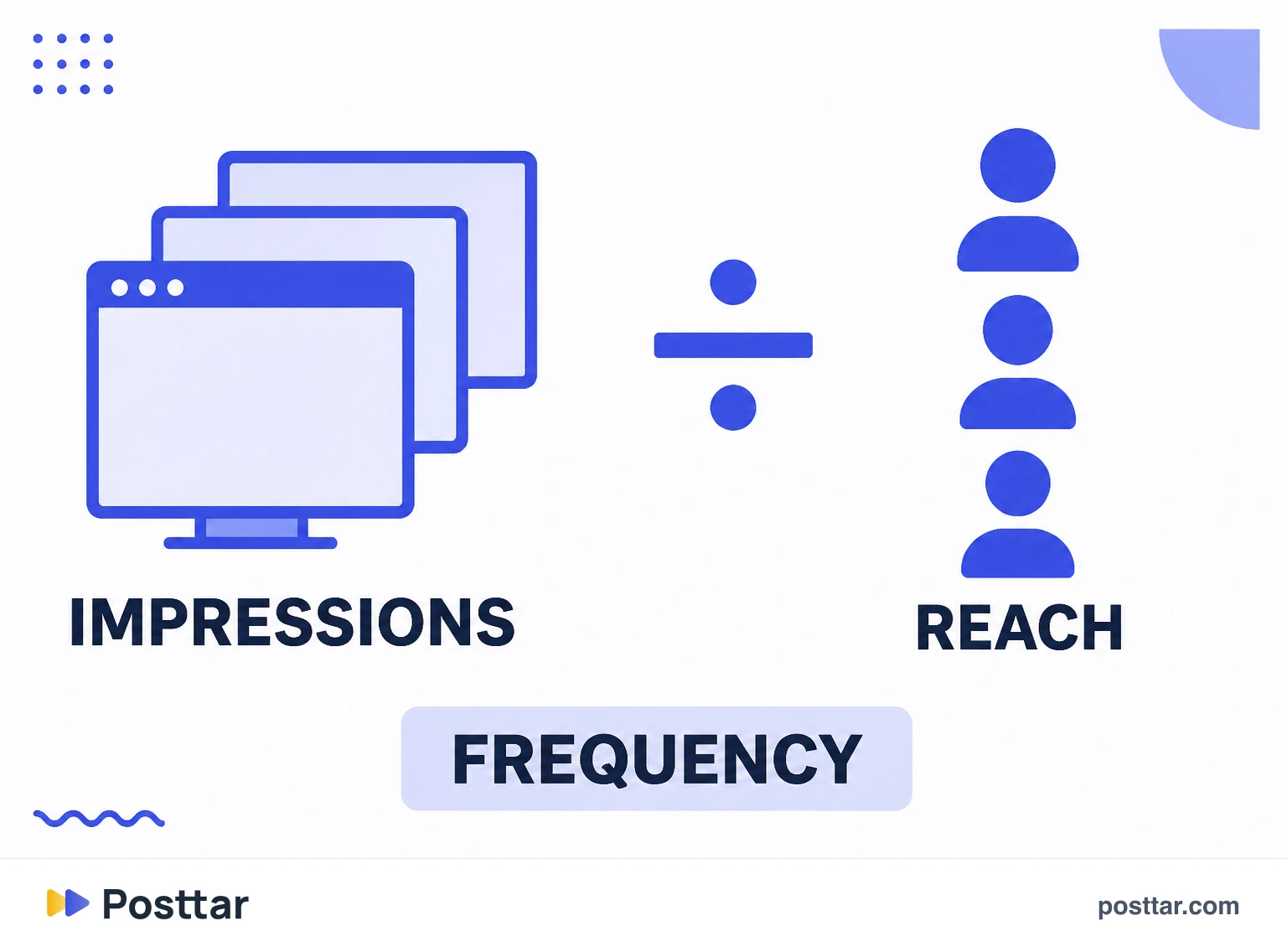
- Formula: impressions divided by reach.
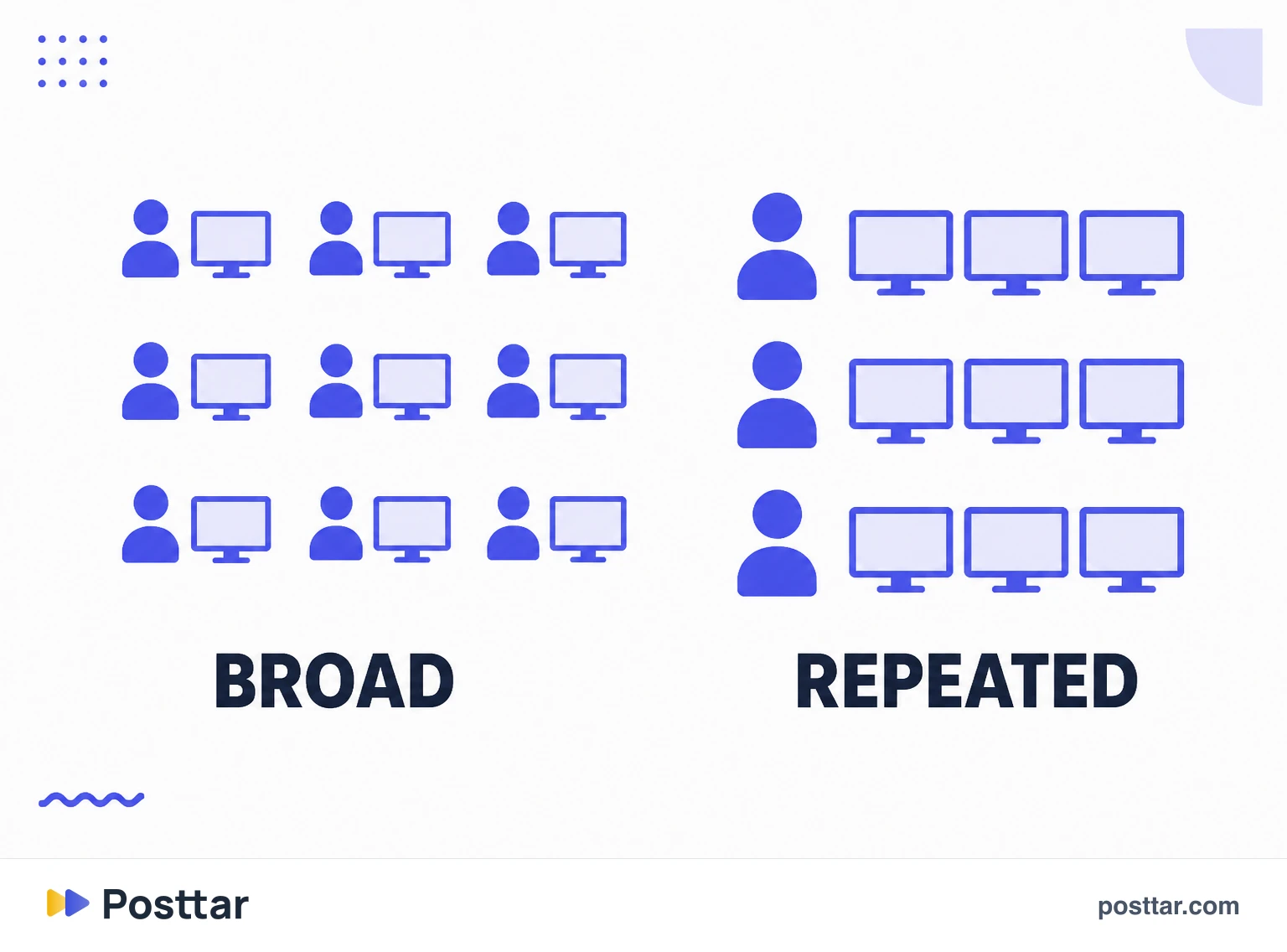
- Close to 1: broad delivery, almost nobody saw it twice.
- Above 2 or 3: the content circulated inside the same audience.
- Not posting frequency, which is how often you publish.
What frequency is
Frequency is a ratio, not a count. It comes from dividing impressions by reach, and answers a question neither one answers alone: did delivery go to many people or to few people several times.
The clearest example: 10,000 impressions can mean 10,000 people seeing it once each, frequency 1, or 1,000 people seeing it ten times, frequency 10. Both scenarios share the same volume and mean opposite things.
There is a vocabulary ambiguity that gets in the way. In paid media, frequency is always this ratio. In organic social conversation, many people say "frequency" meaning posting frequency, which is something else: how many times a profile publishes per week.
How to calculate it and what to expect
The maths is simple and Instagram does not hand it over in organic, so it falls to whoever is analysing.
| Impressions | Reach | Frequency | Reading |
|---|---|---|---|
| 12,000 | 11,500 | 1.04 | broad delivery, no repetition |
| 12,000 | 6,000 | 2.0 | half saw it twice |
| 12,000 | 2,000 | 6.0 | circulated in the same bubble |
On an organic feed post, frequency tends to sit close to 1, because people see it and scroll. On Reels it climbs, because the format is revisited and looping counts. In Stories it climbs too, since the sequence is opened more than once during the day.
Is high frequency good or bad
It depends entirely on the goal of the content, and that is the honest answer.
- Good when the goal is recall. Brands are built by repetition. Nobody remembers something they saw once.
- Bad when the goal is discovery. Repeating to people who already saw it is reach that did not become new people.
- A warning sign in paid media. Frequency rising while results fall is creative fatigue, and the fix is changing the piece, not raising the budget.
In organic, very high frequency with a falling engagement rate usually means the content saturated the base and is not finding new audience.
The most common reading errors
- Calling frequency reach. They are different dimensions: one is how many people, the other is repetition.
- Calculating at profile level and comparing to post level. Both frequencies exist and are not interchangeable.
- Comparing formats. A Reel's natural frequency is higher than a photo's, and that says nothing about quality.
- Chasing a number. There is no universal ideal frequency. There is a frequency consistent with what the piece was supposed to do.
Checklist
- I made clear whether I mean delivery frequency or posting frequency.
- I calculated with impressions and reach from the same scope and period.
- I read the number against the goal of the piece, not against an ideal.
- I compared format with format.
- In paid campaigns, I treated rising frequency with falling results as creative fatigue.
Frequently asked questions
How do you calculate frequency on Instagram?
Divide impressions by reach for the same content and the same period. The result is how many times, on average, each person reached saw the piece. The app does not show that calculation for organic content.
What is the difference between frequency and reach?
Reach counts how many distinct people saw it. Frequency says how many times each of them saw it, on average. Reach is a count, frequency is a ratio between impressions and reach.
What metric does Instagram use for repetition?
The app does not expose a metric called frequency for organic content. It gives impressions and reach separately, and repetition comes from dividing one by the other. In paid media, Ads Manager shows the calculated frequency.
Does high frequency hurt reach?
Indirectly. High frequency means delivery concentrated on people who already saw the content, so fewer new people are being reached. If it comes with falling engagement, it signals base saturation.
What is the ideal frequency to post on Instagram?
That question is about posting frequency, which is a different concept. There is no universal number: what matters is a predictable cadence you can sustain, because irregularity shrinks the pool of people who receive the content in the first moment.
Related concepts
Impressions
Impressions are the total number of times a piece of content was displayed, including repeat views by the same person. Unlike reach, which counts unique accounts, an impression counts the display: if someone sees the same carousel three times, that is one account of reach and three impressions. The ratio between the two is frequency, and it is what shows whether content is circulating inside the same bubble or finding new people.
Read the entry
Reach
Reach is the number of unique accounts that saw a piece of content at least once. Unlike impressions, it does not count the same person twice, so it measures the size of the audience touched rather than the volume of exposure. On Instagram, reach is reported per post and per period, and it can be split between followers and non followers, which is the reading that shows whether a profile is discovering new people or simply circulating among those who already follow it.
Read the entry
Reach rate
Reach rate is the percentage of your follower base that actually saw a piece of content, calculated by dividing reach by follower count. It exists because absolute reach is not comparable across accounts or across moments: a thousand accounts reached is excellent for a profile with two thousand followers and poor for one with two hundred thousand. It turns reach into an efficiency metric instead of a size metric.
Read the entry
Posting frequency
Posting frequency is how many pieces an account publishes per period. There is no universal number, and anyone promising one is selling simplification: the right answer depends on the format, the niche and, above all, what you can sustain. Consistency weighs more than volume, because an account posting three times a week for a year returns more than one posting daily for a month then vanishing.
Read the entry