Middle of funnel: the stage almost nobody produces, and the one that decides the sale

By Tiago Costa·Updated on August 5, 2026
Definition
Middle of funnel is content for people who recognise the problem.
- The most forgotten stage, because it appears to return nothing.
- It is where opinion forms about which path to take.
- It handles objections before the sales conversation starts.
- Measured by saves and comments, not by reach.
Why it gets forgotten
The middle suffers from an appearance problem. It lacks the reach of the top, because it addresses a narrower audience, and it lacks the visible selling of the bottom, because it makes no offer.
Looking only at surface numbers, it seems the worst of the three. That is why most accounts oscillate between top and bottom, and the middle simply does not exist.
The effect is familiar: the account brings in new people and makes offers, but nothing happens in between. People arrive without understanding why that way of solving things is better, and an offer at that point meets an objection that was never handled.
What to produce
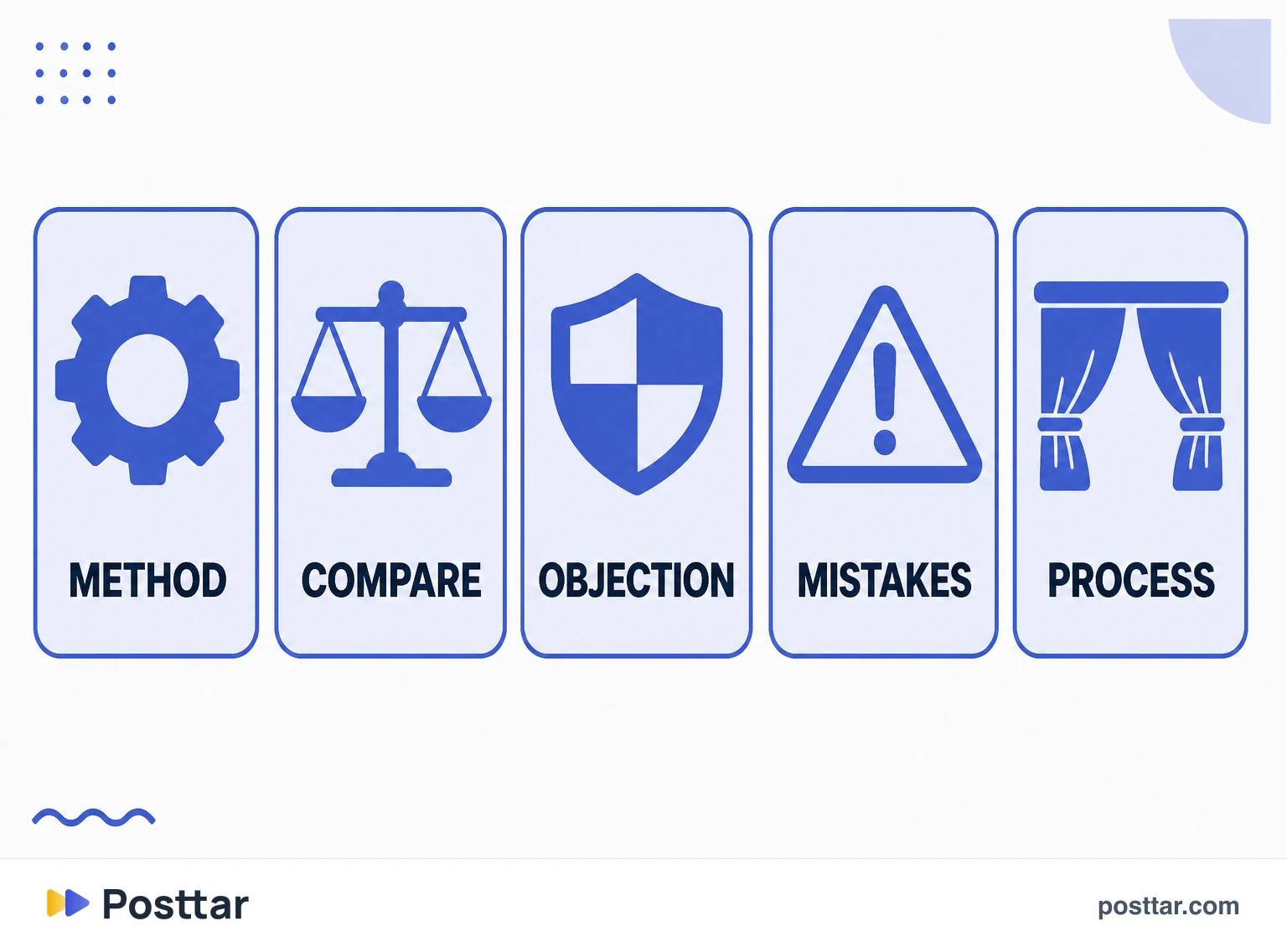
Five types cover almost everything:
- The method. How you solve the problem, genuinely explained. Many people hide this thinking they are giving away gold; in practice, explaining the method is what proves you have one.
- Comparing paths. The three ways of solving it, with the cost and limit of each.
- Objections. "Does this work for someone short on time?", "what if I have no team?". Each objection handled beforehand saves a conversation later.
- Mistakes of people trying alone. It shows mastery without needing to sell yourself.
- Process behind the scenes. How the work happens, which builds confidence in competence.
How to measure it
Judging the middle by reach is the mistake that makes the stage look useless. The right metrics are different:
- Saves. The main one. Middle content gets revisited later, and saving is exactly that behaviour.
- Comments with questions. Unlike reaction comments, a question indicates evaluation in progress.
- Direct messages. Good middle content produces spontaneous conversation, without asking.
- Watch time and slide advance. People evaluating consume to the end.
A useful reading: if your middle content has low reach and high saves, it is working exactly as it should.
The bridge it builds
There is a function of the middle that does not appear in metrics and is the most valuable: it shortens the sales conversation.
Someone arriving in your inbox after consuming middle content already knows how you work, already saw the method and already had the main objections answered. The conversation starts at a different point, often without a price discussion, because value was already built.
Someone arriving without passing through needs all of that in the conversation, which makes it long, repetitive and more dependent on discounts.
That is why the middle has the highest return per piece produced, even while being the one that shows least in the numbers.
Checklist
- I explain my method rather than hiding it.
- I handle objections in content, before the conversation.
- I measure by saves and questions, not by reach.
- Middle content exists in my last month.
- I compare paths instead of only defending mine.
Frequently asked questions
What is middle of funnel content?
It is content for people who already recognise the problem and are evaluating how to solve it. It is where someone forms their opinion about which path to take, and therefore about whom to take it with.
What content belongs in the middle of the funnel?
An explanation of your method, a comparison of the possible paths, objection handling, the mistakes of people trying to solve it alone, and behind the scenes of your work process.
How do you measure middle of funnel content?
By saves, comments containing questions, spontaneous direct messages and consumption time. Low reach with high saves is the expected pattern, and it means the piece is working.
Why is the middle of the funnel the most forgotten stage?
Because it has neither the reach of the top nor the visible selling of the bottom, so it looks like the worst stage in surface numbers. The result is accounts oscillating between attracting and offering, building nothing in between.
Does explaining my method give away too much?
In practice, explaining the method is what proves you have one. Execution remains the differentiator, and content that hides the how sounds vague, which undermines exactly the trust this stage is supposed to build.
Related concepts
Content funnel
A content funnel organises pieces according to the consumer's decision stage: top for people who do not yet know the problem, middle for people already looking for a solution, bottom for people deciding. It solves the most common imbalance in professional accounts, which is producing only one type, and therefore growing without selling or selling without growing.
Read the entry
Top of funnel
Top of funnel is content made for people who do not know you yet, and frequently do not know they have the problem you solve. It is the broadest stage and the only one bringing new people in, which makes it the growth source of an account. In exchange, it is the one that sells least directly, and trying to sell there is the mistake that most destroys this stage reach.
Read the entry
Bottom of funnel
Bottom of funnel is content for people who already decided to solve the problem and are choosing whom to solve it with. It deals with proof, pricing, guarantees and offer detail. It is the stage that reaches least and converts most, and understanding that trade is what prevents the wrong conclusion that it does not work simply because it gets fewer views.
Read the entry
Saves
A save is when someone files your post away to return to it later. It is a private interaction: it does not appear on the post, nobody but the saver knows, and you only see the aggregate total in insights. Precisely because it has no social component, it is one of the most honest signals available, since people save for their own usefulness rather than to be seen saving.
Read the entry