Narrative arc: a story's tension curve, and how it fits in thirty seconds

By Tiago Costa·Updated on August 5, 2026
Definition
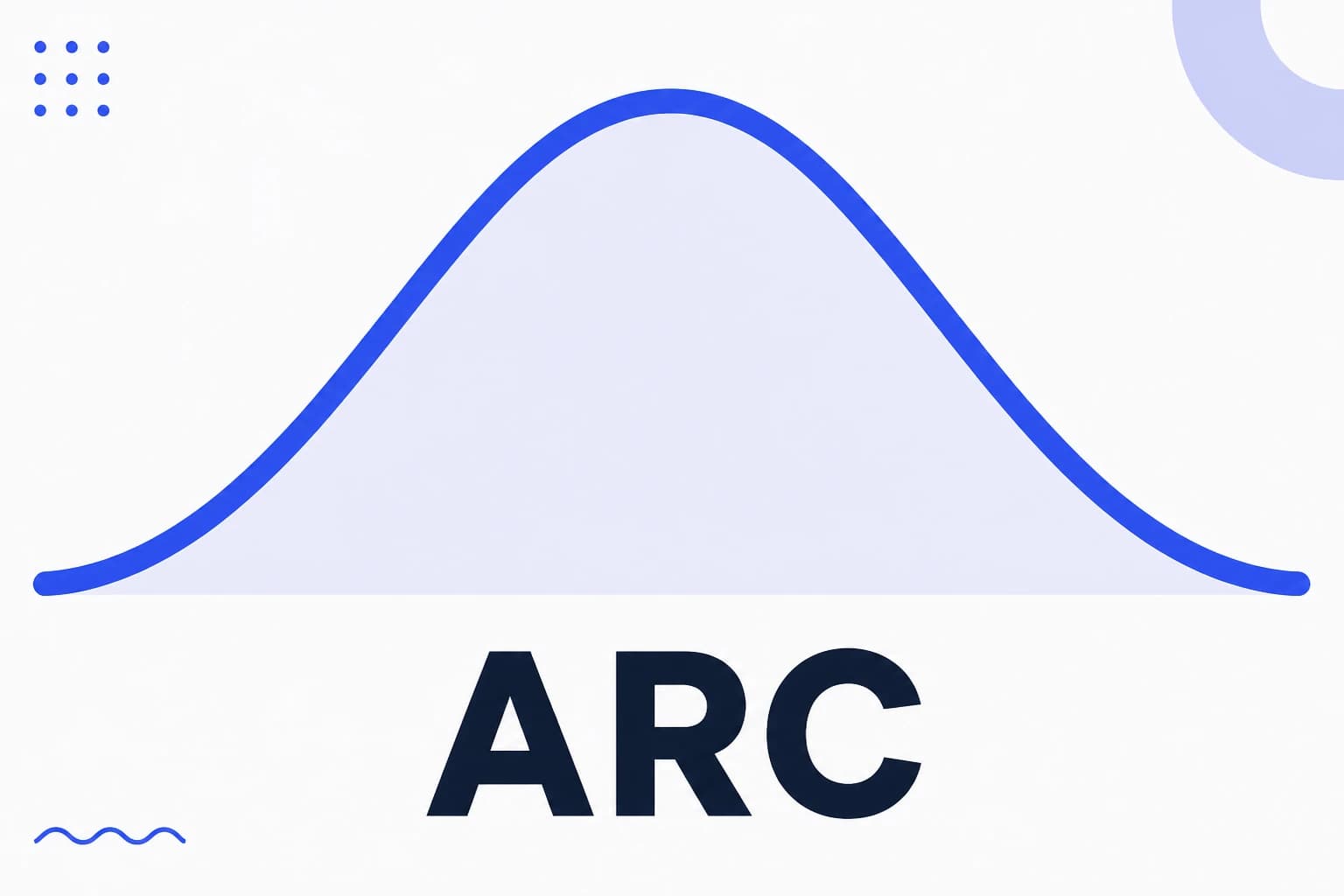
A narrative arc is the tension curve rising to a climax and resolving.
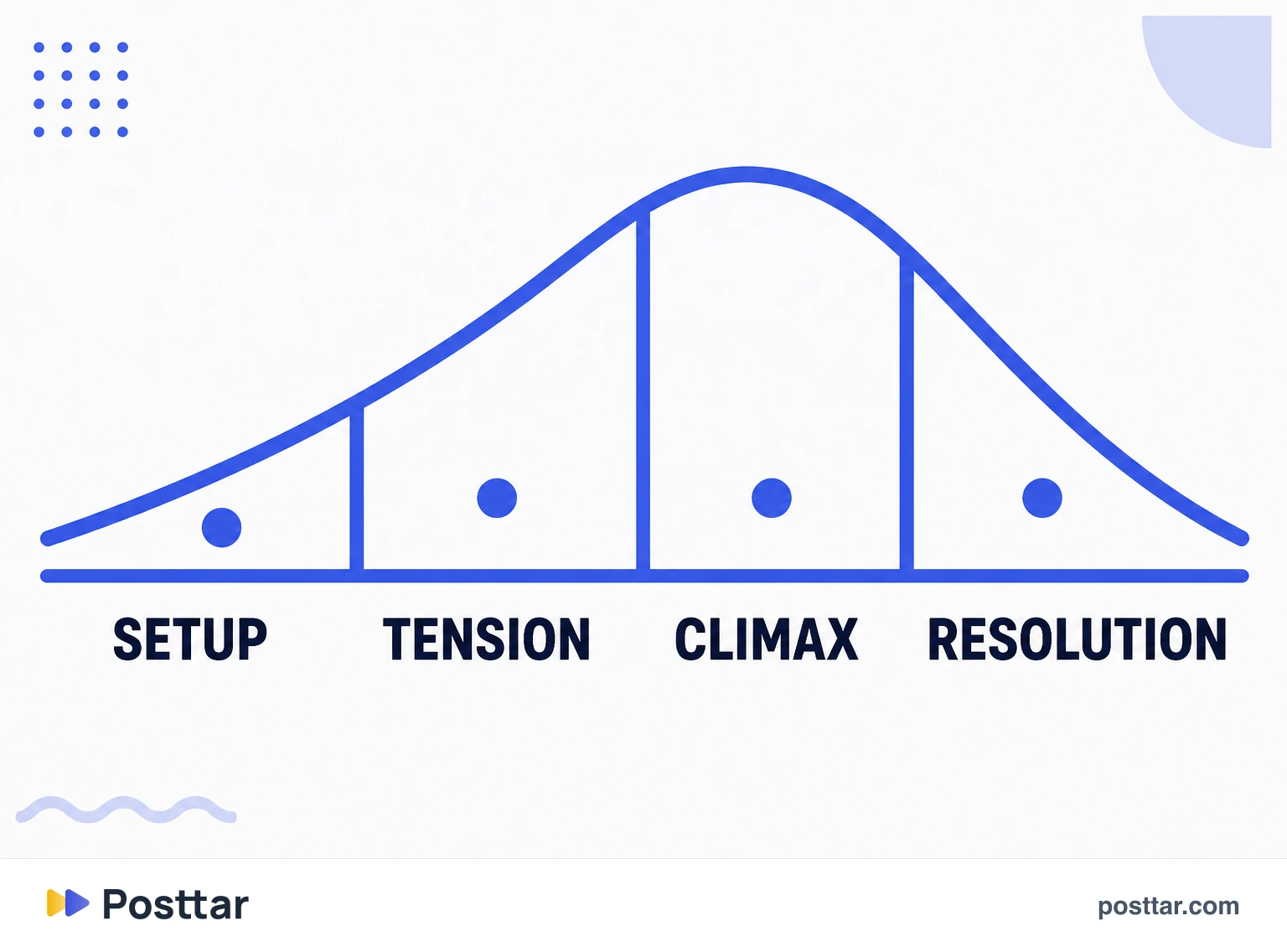
- Setup, rising tension, climax and resolution in four beats.
- It separates a story from a list of events.
- It fits in thirty seconds, compressed.
- Without rising tension the audience leaves halfway.
The curve, in four beats
- Setup. Who, where, what the normal situation is. In short content that is seconds, not minutes.
- Rising tension. Something threatens the normal situation, and the complication grows. It is the longest part and the one that holds.
- Climax. The point of highest tension, where things are decided.
- Resolution. How it ended, and what changed because of it.
The curve matters more than the names. What the audience feels is the slope: while tension rises they stay; when it flattens too early they leave.
Which is why content that "tells what happened" in chronological order tends to lose people. Chronology is not an arc: real life rarely organises facts into rising tension.
How to compress it for short content
In a thirty second Reel, each beat gets a few seconds, and the cutting has to be brutal.
Three decisions that make it fit:
- Start after the setup. Opening in the middle of the tension and explaining context afterwards is the format's default, and it works as an automatic hook.
- One complication only. There is no room for a double twist.
- Short resolution. After the climax, attention collapses. One sentence is enough.
In a carousel the arc is distributed across slides, and the turn usually lands in the middle, to hold the swipe through to the end.
Where the arc breaks
- Tension that does not rise. A sequence of equally interesting facts is a straight line, and a straight line does not hold.
- An early climax. Delivering the outcome too soon removes the reason to continue. It is the mistake of using the result as the hook and leaving nothing after.
- Missing resolution. Ending without closing frustrates, and frustration does not generate shares.
- A resolution that runs long. The opposite: after the climax, every extra second is retention loss.
Beyond personal stories
Narrative arcs are not just for life stories. They work as structure for content that is not a story at all:
- Tutorial. Setup is the problem, tension is the difficulty, climax is the key insight, resolution is the result.
- Analysis. Situation, a complication nobody saw, discovery, consequence.
- Client case. The most direct format, and the most underused on professional accounts.
The practical gain of seeing it this way: educational content structured as an arc retains better than the same content structured as a list, because a list can be abandoned at any item with no sense of loss.
Checklist
- Tension rises across the piece rather than staying flat.
- I started after the setup, not before it.
- There is an identifiable climax.
- The resolution exists and is short.
- I did not deliver the outcome right at the start.
Frequently asked questions
What is a narrative arc?
It is a story's tension curve: the structure by which a conflict is introduced, grows to a point of maximum tension and resolves. It is what turns a sequence of events into a story rather than a list.
What are the stages of a narrative arc?
Setup, rising tension, climax and resolution. The curve matters more than the names: while tension rises the audience stays, and when it flattens too early the audience leaves.
Can you use a narrative arc in short video?
Yes, compressed. Start after the setup, use one complication only and close with a one sentence resolution. A thirty second video holds the entire curve, and compression usually makes it more visible.
What is the difference between a narrative arc and the hero's journey?
The narrative arc is the general tension structure present in any story. The hero's journey is a specific model with named stages such as the call, the ordeal and the return, and it is one of the possible ways of filling that arc.
Does educational content need an arc?
It does not need one, but it retains better with one. A tutorial structured as problem, difficulty, turn and result holds better than the same content as a list, because a list can be abandoned at any item with no sense of loss.
Related concepts

Storytelling
Storytelling is the practice of organising a message as a story, with a character, a conflict and a resolution, instead of presenting it as a direct argument. It works because story is the format human memory keeps best: the same information embedded in a narrative is remembered far more than the same information listed. What separates a story from an account is conflict.
Read the entry
Hero's journey
The hero's journey is the narrative model describing the structure repeated across myths and stories: an ordinary person receives a call, resists, crosses an ordeal with a mentor's help and returns transformed. Applied to marketing it is useful, but with an inversion almost everyone gets wrong: the one telling the story is not the hero, they are the mentor.
Read the entry
Hook
A hook is the opening of a piece of content, responsible for buying the first seconds of attention and making someone decide to keep going. In short video it occupies the first three seconds and is simultaneously verbal, visual and sonic; in a carousel it is the cover; in text it is the first line. A hook is not decoration: because the distribution system watches retention and dwell time, it determines whether the content ever gets delivered beyond the people who already follow you.
Read the entry
Video script
A video script is the document defining what will be said and shown in a video before recording begins. In short content it is almost never read word for word, but writing beforehand changes the result anyway: it forces the hook to be decided, cuts rambling and reduces the number of takes. The arithmetic is simple, a script costs ten minutes and saves an hour of editing.
Read the entry