Save rate: the usefulness signal almost nobody tracks

By Tiago Costa·Updated on August 5, 2026
Definition
Save rate is the percentage of people who saw the content and filed it for later.
- Formula: saves divided by reach, times 100.
- It measures perceived usefulness, not approval.
- It varies heavily by format. Carousels lead, comedy Reels do not.
- It is the best topic guide insights hand you.
How to calculate it
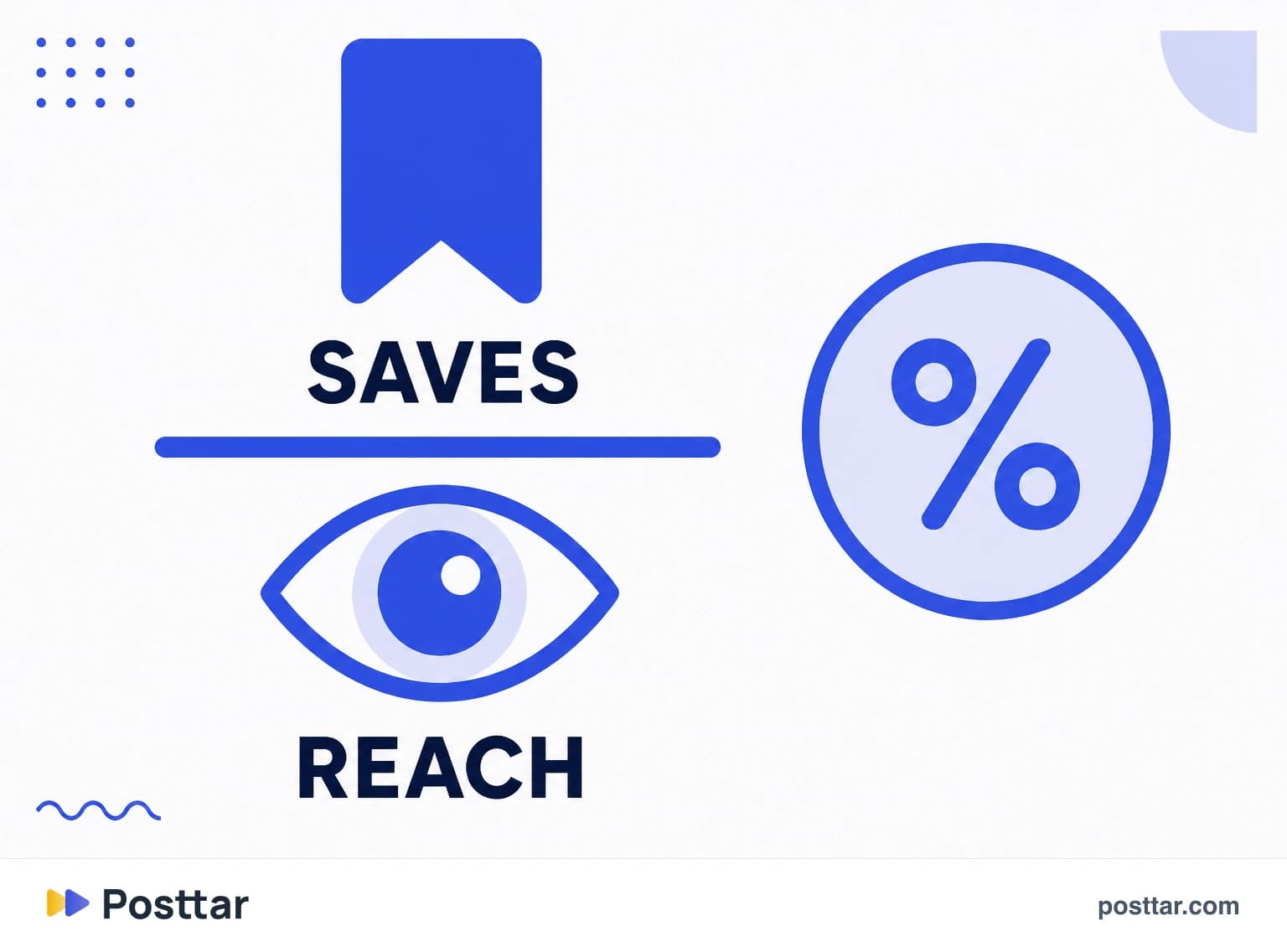
Save rate = saves ÷ reach × 100
The denominator is reach and not follower count, for the usual reason: it only makes sense to ask how many saved among the people who had the chance to save. Whoever did not see it should not be in the calculation.
Instagram gives both raw numbers in the insights of a professional account and does not do the division. One trap when collecting: both have to come from the same time window. Saves keep accumulating for days, so pairing a week of saves with 24 hours of reach inflates the result.
What the rate exposes
It is the metric that separates content that was consumed from content that was used, and that distinction changes what you produce.
- High rate with low likes: pure reference content. Not applauded, filed. Worth repeating.
- High likes with a low rate: it pleased and did not serve. Good for relationship, weak for authority.
- High and rising rate on a topic: it found a real pain. That is the definition of a topic worth turning into a series.
- Rate collapsing on the same topic: the subject saturated, or the format became repetitive.
Why comparing across formats distorts
Save rate is strongly tied to format, far more than the overall engagement rate.
The carousel is the format of consultable content, so it leads comfortably. Utility Reels also save well; comedy Reels barely save at all, and that does not make them worse, it means they serve a different function.
So: compare carousels with carousels. A profile-wide average mixes functions and produces a number that guides nothing.
How to use it in practice
- Rank topics by rate, not by likes. That is where the authority signal lives.
- Turn the top three into a series. If people filed it once, they will file it again.
- Redo what had a high rate and low reach. The content worked and only distribution was missing, so rewrite the hook and republish.
- Do not chase the rate on relationship content. Behind the scenes and opinion do not need to be saved.
- Give it time. Reference content gets saved when the person needs it, not when they see it.
Checklist
- I divide by reach, not by follower count.
- I use saves and reach from the same time window.
- I compare format with format.
- I use the median of the last thirty as a baseline.
- I treat the rate as a topic guide, not as a grade for the content.
Frequently asked questions
How do you calculate save rate on Instagram?
Divide the number of saves by the post's reach and multiply by 100. Use both numbers from the same time window, because saves keep accumulating for days and so does reach.
What is a good save rate?
There is no universal number, and it varies heavily by format: a reference carousel usually sits well above a comedy Reel. The reliable benchmark is the median of your last thirty pieces of the same format.
Why does save rate matter more than like rate?
Because saving costs the viewer more and signals future usefulness rather than passing approval. As a distribution signal it weighs more, and as a topic guide it points precisely at what your audience considers worth consulting.
Can I see who saved my post?
No. Insights only show the total, with no identification. A save is a private interaction, and that is exactly what makes it an honest signal.
Does a low save rate mean bad content?
Not necessarily. Opinion, behind the scenes and humour have low rates by nature, because they are not made to be consulted later. The problem is content that promised to be a reference and did not get saved.
Related concepts

Saves
A save is when someone files your post away to return to it later. It is a private interaction: it does not appear on the post, nobody but the saver knows, and you only see the aggregate total in insights. Precisely because it has no social component, it is one of the most honest signals available, since people save for their own usefulness rather than to be seen saving.
Read the entry
Engagement rate by reach
Engagement rate by reach is the percentage of people who saw a piece of content and reacted to it, calculated by dividing total interactions by reach. Unlike the follower-based rate, it removes from the calculation everyone who never saw the post, which makes it the correct reading for judging content. In exchange, it can only be calculated by someone with access to insights, which makes it useless for comparing profiles from outside.
Read the entry
Reach
Reach is the number of unique accounts that saw a piece of content at least once. Unlike impressions, it does not count the same person twice, so it measures the size of the audience touched rather than the volume of exposure. On Instagram, reach is reported per post and per period, and it can be split between followers and non followers, which is the reading that shows whether a profile is discovering new people or simply circulating among those who already follow it.
Read the entry
Carousel
A carousel is the Instagram post that holds up to 20 images or videos in a single publication, navigated by swiping sideways. It occupies the same feed space as a regular post but asks the viewer for one extra action, and that action is what makes it valuable: every frame advance adds dwell time, and the format gets a second delivery chance, because Instagram can re-show the post starting from a different frame to people who did not interact the first time.
Read the entry