Copywriting: writing to make someone act, and why it is not writing beautifully

By Tiago Costa·Updated on August 5, 2026
Definition
Copywriting is writing built to provoke a specific action.
- Judged by results, not by the beauty of the prose.
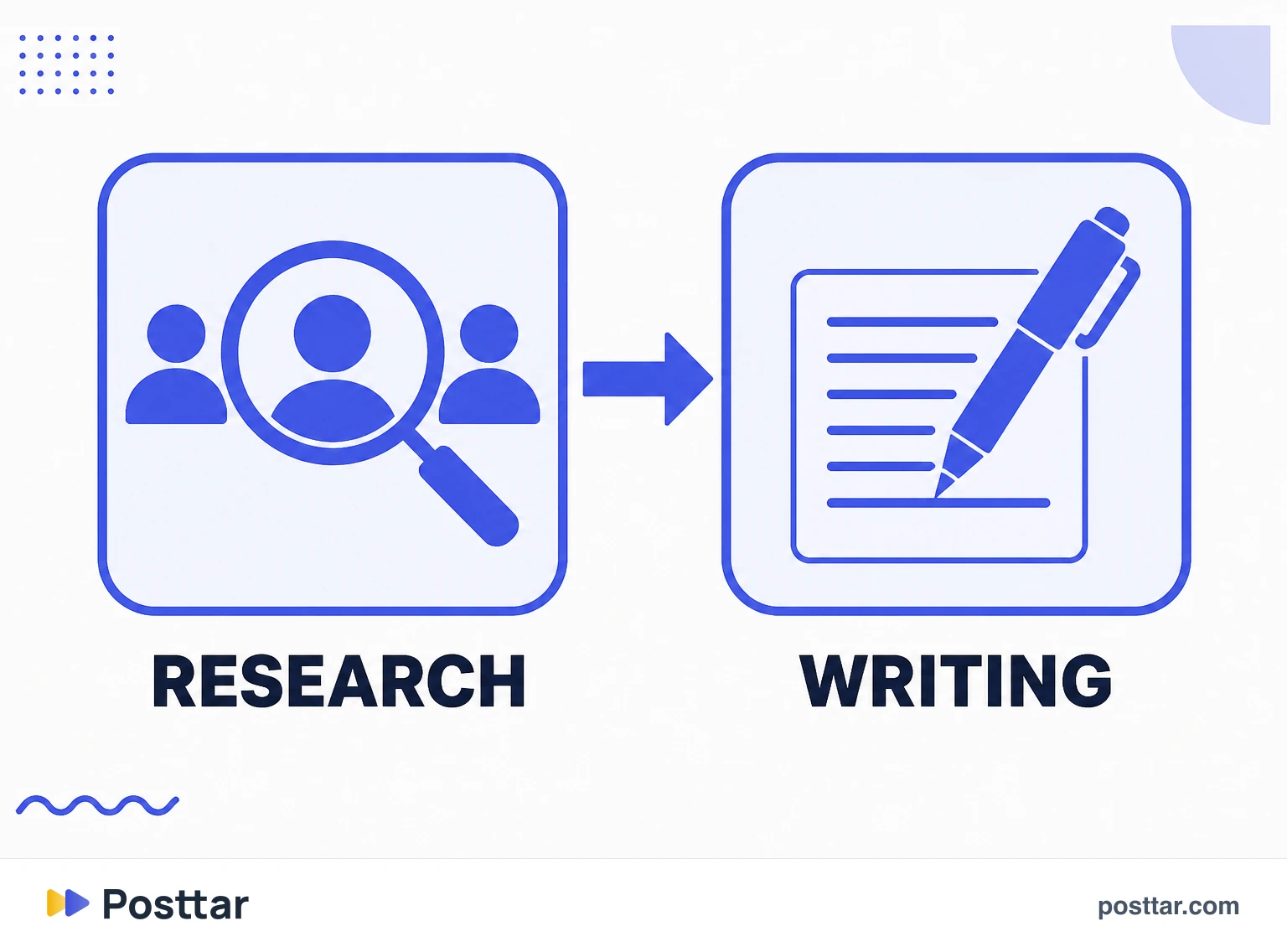
- It starts with research, not with inspiration.
- Clarity beats style in practically every test.
- It talks about the reader, not about the writer.
What it is, and what it is not
Copy is any text whose objective is an action. An ad, a sales page, an email, a caption, a video script, a button. If there is something you want a person to do after reading, it is copywriting.
Two common confusions:
- It is not creative advertising writing. That chases brand recall and awards; copy chases conversion. Sometimes they coincide, often they do not.
- It is not writing beautifully. An elegant sentence that moves nobody is bad copy, however good it sounds. Clumsy text that sells is good copy.
The discomfort in that definition is deliberate. Copy is an engineering discipline, with hypotheses and measurement, more than an art.
The work starts before writing
This is the point that most separates people who know from people who think they know. Most of the result comes from research rather than from the writing itself.
Before writing, you need to know:
- Who you are talking to and what stage of awareness they are at: do they know they have the problem? are they already looking for a solution? do they already know you?
- Which specific pain. Not the pain category, the sentence the person uses to describe it.
- What objections exist and in what order they show up.
- What competitors already said, because repeating the same argument does not differentiate.
The best source is the customer's literal language: comments, direct messages, sales call recordings, product reviews. The strongest copy is almost always a sentence the customer already said, handed back with clarity.
The elements involved
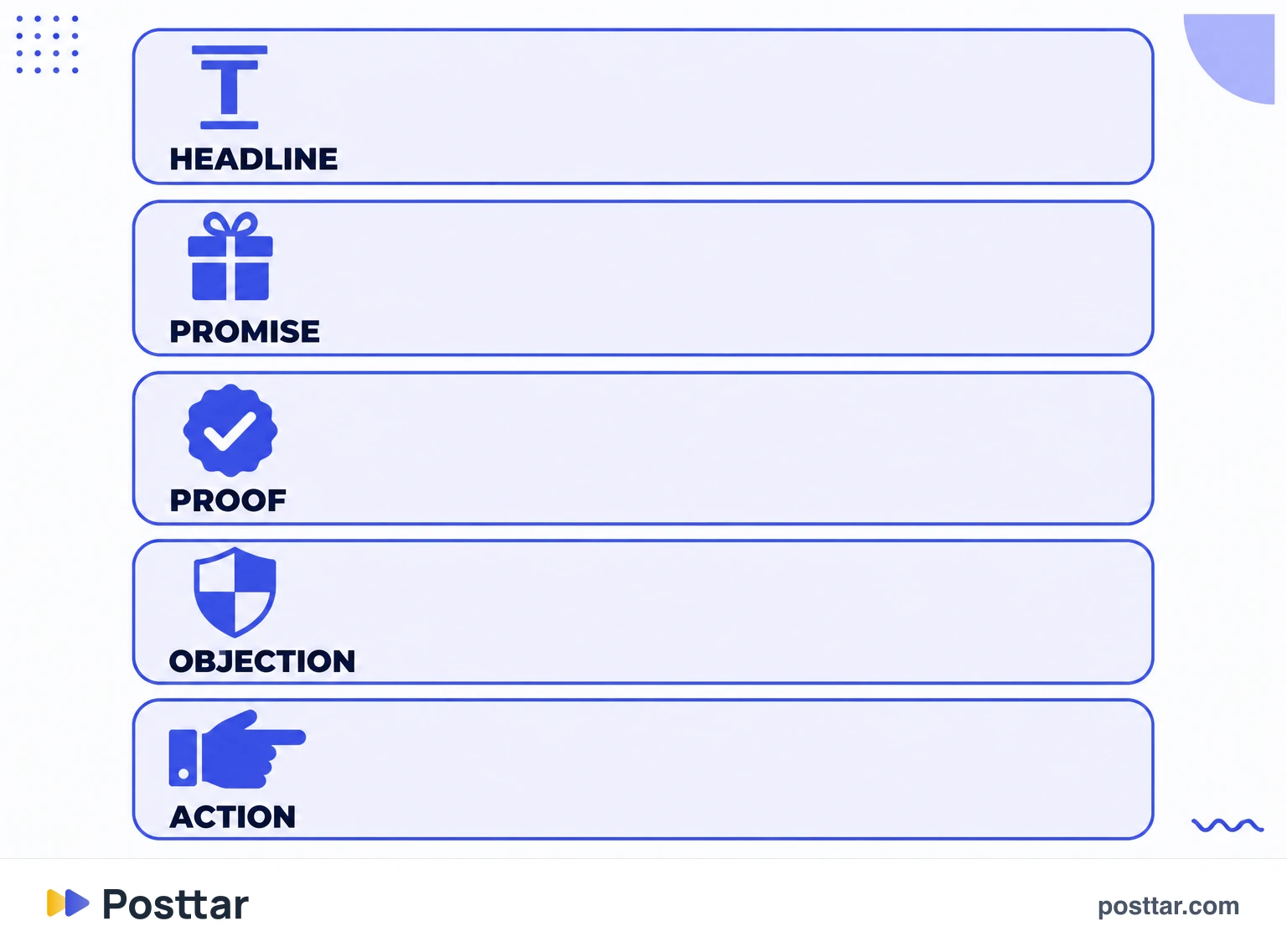
- Headline. What makes people stop. Without it, the rest goes unread.
- Promise. What the person gains, in their terms.
- Proof. Why to believe: a number, a case, a demonstration, a guarantee.
- Objection answered. What would make the person quit, handled before they think of it.
- CTA. What to do now, specific and with a reason.
There are ready made structures organising this, and they are worth knowing as scaffolding rather than as a mould. The good news is there are few of them and they repeat: almost all working copy is a variation of problem, agitation, solution.
The mistakes that always show up
- Talking about yourself. "We are a company with 20 years in the market" is nobody's benefit. Translate everything into what the person gains.
- Adjectives instead of proof. "Innovative and complete solution" says nothing. Numbers and demonstrations say something.
- Writing for everyone. Generic copy moves nobody, because it does not seem to be about anybody.
- Decorating. Every extra word is another chance for the person to leave.
- Never measuring. Copy without measurement is opinion, and the writer's opinion is the least reliable of all.
Checklist
- I know what awareness stage the reader is at.
- I used the customer's literal language, not mine.
- Every strong claim has proof beside it.
- I swapped adjectives for numbers wherever possible.
- There is a way to measure whether it worked.
Frequently asked questions
What is copywriting?
It is writing built to provoke a specific action, such as buying, signing up or replying. What sets it apart is not style but the success criterion: copy is judged by how many people did what it asked.
What does a copywriter do exactly?
Researches the audience and the competition, defines the argument, writes the text and measures the result to adjust. The writing part is the smallest: most of the result comes from research done before the first sentence exists.
How can I start copywriting?
Start by hand copying texts that provably sold, to internalise the structure, and practise research: read comments, messages and reviews from a product's audience until you can write their pain using their own words.
Is ChatGPT going to replace copywriting?
It already drafts competently, which changes what the work is worth. What stays scarce is what comes before: knowing who you are addressing, which objection to handle and which argument is actually true about that product, plus the measurement afterwards.
What is the difference between copywriting and content writing?
Copywriting aims at a specific action and is judged by conversion. Content writing aims to inform or entertain and is judged by attention and trust built over time. The same person often does both, but the success criteria are different.
Related concepts

Headline
A headline is the opening line that decides whether the rest of the content gets consumed. It is the highest leverage element of any piece: if it fails, everything after it stops existing, however good it is. On Instagram it appears in three different places, and each carries a constraint of its own that changes how it should be written.
Read the entry
CTA
CTA stands for call to action: the instruction telling a person what to do next. It is the element that turns attention into results, and the most wasted of all, because most pieces either ask for nothing or ask for several things at once. One ask per piece, specific and with a reason, returns more than the full list of verbs.
Read the entry
Psychological trigger
Psychological trigger is the popular name for the shortcuts the brain uses to decide without analysing everything. They come from persuasion psychology research and describe real behavioural tendencies, such as trusting demonstrated authority or valuing what is scarce. What circulates as a list of dozens of triggers is almost always the same half dozen principles renamed.
Read the entry
Storytelling
Storytelling is the practice of organising a message as a story, with a character, a conflict and a resolution, instead of presenting it as a direct argument. It works because story is the format human memory keeps best: the same information embedded in a narrative is remembered far more than the same information listed. What separates a story from an account is conflict.
Read the entry