CTA: the call to action, and why asking for everything at once produces nothing

By Tiago Costa·Updated on August 5, 2026
Definition
A CTA is the call to action: what to do next.
- One ask per piece. Several asks cancel each other out.
- Specific beats generic. "Comment" does not say what to comment.
- It needs a reason. With no clear benefit, the ask is ignored.
- Not every piece needs one.
What it is
A CTA is the explicit instruction about what to do now: save, comment, send to someone, click the link, send a message, buy.
Its reason to exist is dull but true: people do not act on their own. They watch, they agree, they keep scrolling. The ask is what converts attention into action, and without it much of a piece's value evaporates.
That is different from being pushy. A clear, justified ask is a service; the problem is not asking, it is asking badly.
The mistakes that cancel the ask
- Asking for several things. "Like, save, comment, share and follow me" does not produce five actions, it produces zero. More choice is no choice.
- Too generic. "Comment below" does not say what to write, so nobody writes. "Tell me in one word which of these you have done" already has an answer forming in the reader's head.
- No reason. "Save this post" is an order. "Save it so you have it when you sit down to do it" is a benefit.
- Asking for what makes no sense. Asking for shares on a piece nobody would send to another person only highlights that it did not deserve sharing.
- Asking too early. Before delivering value, any ask sounds like a bill.
How to write one that works
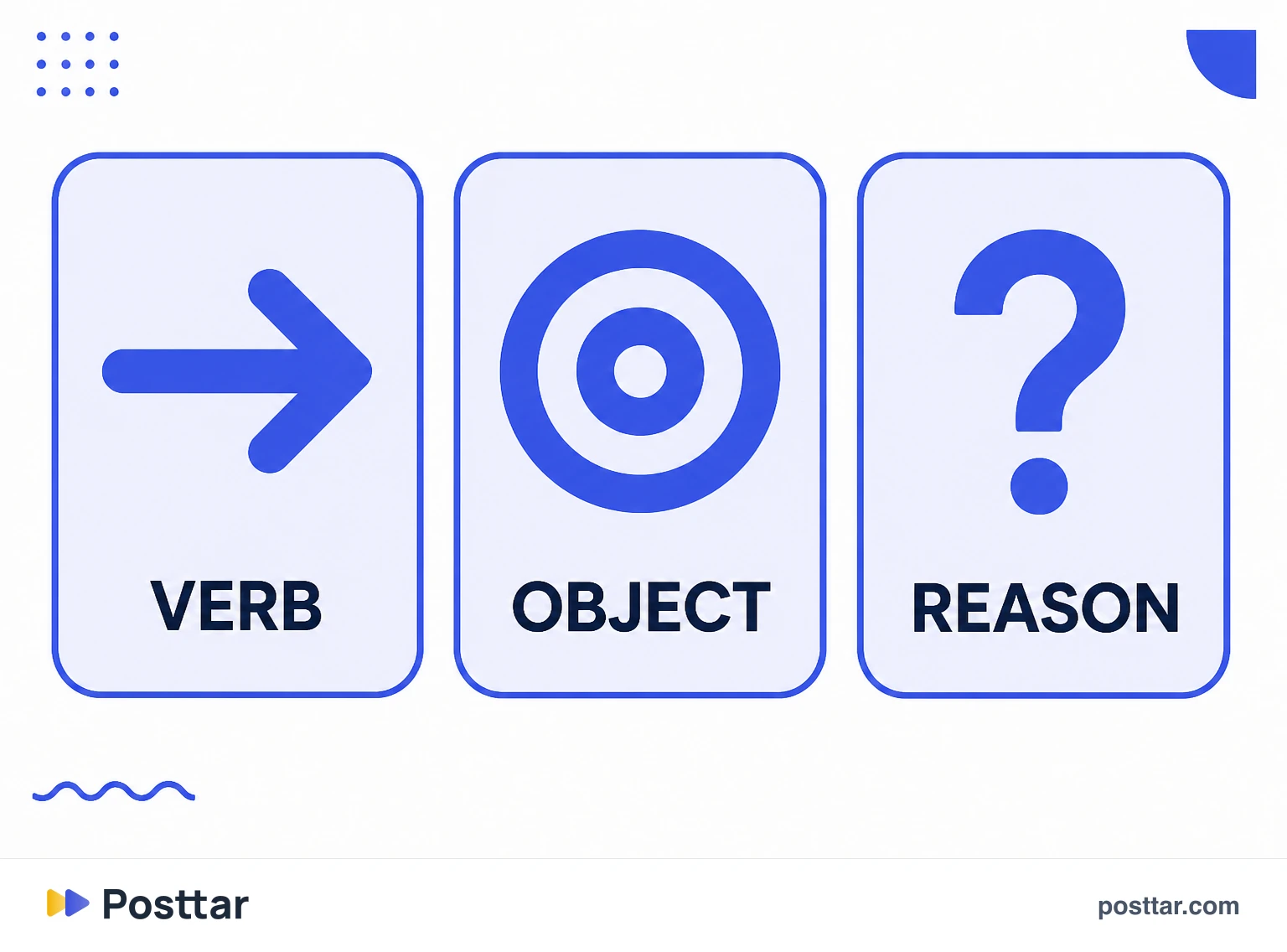
Three ingredients, in this order:
- A clear imperative verb. No hedging, no conditionals.
- The exact object. What to save, what to comment, who to send it to.
- The reason. What the person gains by doing it.
A quick test: read your CTA and ask "why?". If the piece does not answer, the reason is missing.
And choose the ask according to the real objective. Saves for reference content, shares for content someone wants to show another person, comments when there is an opinion to give, a Direct message when the next step is a conversation.
When to ask for nothing
Not every piece needs a CTA, and forcing one onto all of them tires the audience.
Purely positioning content, a personal story or an opinion works better with no ask: its effect is long term, and a call at the end breaks the tone.
There is also the implicit CTA, which is the most elegant: a piece ending in a genuine question, or leaving an unresolved tension, generates comments without asking. That is worth more than any instruction.
Outside the caption there are structural asks: the bio link and the highlights work as a permanent CTA, and that is where most accounts should look before optimising the closing line of each post.
Checklist
- I ask for one thing per piece.
- The ask is specific, with an exact object.
- There is a stated reason, not just an order.
- I ask after delivering value, not before.
- I leave pieces with no CTA when an ask would break the tone.
Frequently asked questions
What does CTA stand for?
It stands for call to action. In content and marketing it means any explicit request for a specific action, whether at the end of a text, on a button or spoken in a video.
What is a CTA and what is it for?
It is the instruction telling someone what to do next: save, comment, send to someone, click the link. It exists to turn attention into action, because people rarely act on their own after consuming content.
How do you write a good CTA?
Use a clear imperative verb, state the exact object of the action, and give the reason it is worth doing. And ask for one thing only: a stack of piled up requests tends to produce no action rather than several.
Why is my CTA not working?
The most common reasons are asking for several things at once, being so generic that the person does not know what to write, giving no reason to act at all, and asking before having delivered any value.
Does every post need a CTA?
No. Positioning content, personal stories or opinion pieces usually work better without one, because a call at the end breaks the tone. There is also the implicit CTA: a piece leaving an unresolved tension generates comments without asking.
Related concepts
Copywriting
Copywriting is writing built to provoke a specific action: buy, sign up, reply, click. What separates it from other kinds of writing is not style, it is the success criterion. A literary text is judged by the experience it creates; copy is judged by how many people did what it asked. That changes everything, including the order in which it gets written.
Read the entry
Instagram caption
A caption is the text accompanying an Instagram post. It holds 2,200 characters, but only the first lines appear before the "more" button, which makes it a two layer format: the opening has to earn the tap, and the rest has to deliver what the opening promised. It is also the main place where the platform reads the subject of the piece as text.
Read the entry
Hook
A hook is the opening of a piece of content, responsible for buying the first seconds of attention and making someone decide to keep going. In short video it occupies the first three seconds and is simultaneously verbal, visual and sonic; in a carousel it is the cover; in text it is the first line. A hook is not decoration: because the distribution system watches retention and dwell time, it determines whether the content ever gets delivered beyond the people who already follow you.
Read the entry
Link clicks
Link clicks is the number of taps on the clickable links of a profile and Stories: the bio link, action buttons and the link sticker. It is the metric that closes the funnel inside Instagram, because it marks the moment someone leaves the app. The insights number almost never matches your website analytics, and the reasons for that are well known and do not indicate an error.
Read the entry