Storytelling: telling a story to make an idea stick, and what separates a story from an account

By Tiago Costa·Updated on August 5, 2026
Definition
Storytelling is organising a message as a story.
- Character, conflict and resolution are the minimum.
- Without conflict it is an account, not a story, and it does not hold.
- It is remembered more than the same information in a list.
- It fits in 30 seconds, no long format required.
The three essential elements
Plenty of storytelling explanations turn into a list of ten items. In practice, three are enough for a story to exist:
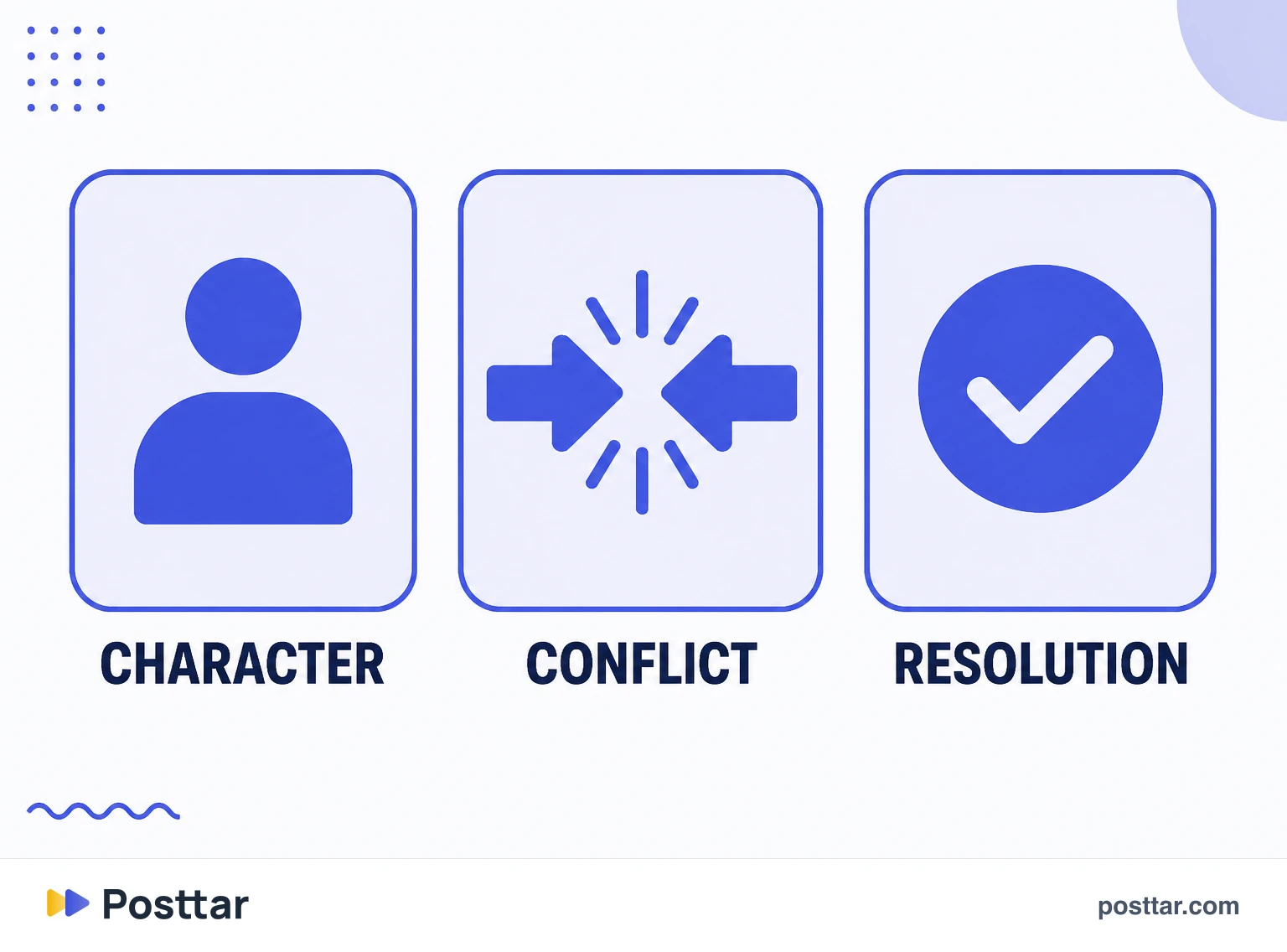
- Character. Someone specific, with a name or a recognisable situation. "A client of mine" works; "people" does not.
- Conflict. An obstacle, a tension, something that might go wrong. It is the element that holds attention, and it is the one almost always missing.
- Resolution. How it ended, and what remained from it.
The test is simple: if you tell it and the person never asks "and then?", there was no conflict, and what you told was an account.
Why it works better than an argument
The practical explanation has three parts.
Retention. A story creates an expectation of an outcome, and that expectation holds the person to the end. A list of arguments can be abandoned at any item with no sense of loss.
Lowered defences. Faced with an argument, people counter argue. Faced with a story, they follow along. The conclusion they draw themselves is stronger than any claim you make.
Specificity. A story forces you to be concrete. "We improved the process" is vague; "Ana spent three hours a week rebuilding the spreadsheet" is an image, and images stick.
How to apply it in short content
There is an idea that storytelling requires a long format. It does not. A thirty second Reel holds the entire structure, and the short version tends to be more rigorous.
A sequence that works:
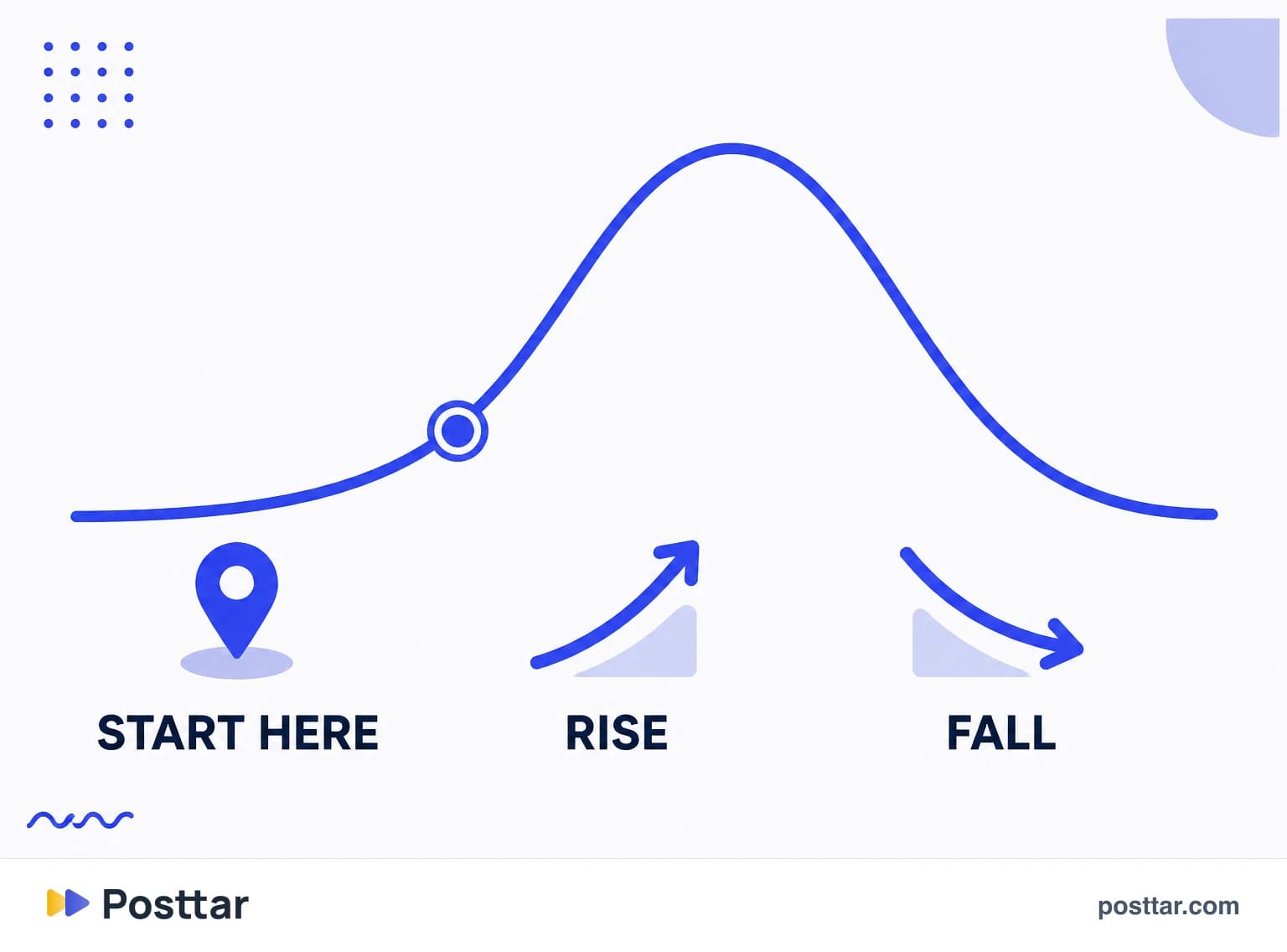
- Start in the middle. Opening at the moment of highest tension gives you a ready made hook. Context comes afterwards, at the bare minimum.
- One conflict only. A short piece has no room for a subplot.
- Cut the preamble. "Last week something interesting happened" is a warm up. Start with the fact.
- Close with what remained. The lesson does not have to be spelled out, but it has to be clear.
Where it goes wrong
- A story disconnected from the message. If the narrative is good but leads nowhere, you entertained and did not communicate.
- The wrong hero. When the teller is always the hero, it tires. The audience identifies with whoever faces the problem, not with whoever already solved everything.
- Invented conflict. Artificial drama over something banal is spotted instantly, and it burns credibility.
- Too long for what it delivers. Three minutes of build up for an obvious conclusion leaves a sense of wasted time.
Checklist
- There is a specific character, not a category of person.
- There is real conflict, not just a sequence of facts.
- I started at the tension, not at the preamble.
- The story leads to the message rather than only entertaining.
- The length is proportional to what the conclusion delivers.
Frequently asked questions
What is the main purpose of storytelling?
To make an idea stick. The same information embedded in a narrative is remembered far more than the same information listed, because a story creates an expectation of an outcome that holds attention and lowers the urge to counter argue.
What are the key elements of storytelling?
At minimum three: a specific character, a conflict creating tension, and a resolution. Models with more stages exist, but without those three there is no story. The element most often missing in practice is conflict.
What is the difference between a story and an account of events?
Conflict. An account is a sequence of facts: this happened, then that. A story has a tension that might go wrong, and that tension is what holds attention through to the outcome.
How do you do storytelling in short content?
Start at the moment of highest tension rather than at the setup, use one conflict only, cut the warm up, and close with what remained. A thirty second video holds the entire structure.
Does storytelling work for any niche?
It works anywhere people are involved, which is almost everywhere. What changes is the source of the story: in technical niches it usually comes from client cases, your own mistakes and hard decisions rather than personal narrative.
Related concepts
Copywriting
Copywriting is writing built to provoke a specific action: buy, sign up, reply, click. What separates it from other kinds of writing is not style, it is the success criterion. A literary text is judged by the experience it creates; copy is judged by how many people did what it asked. That changes everything, including the order in which it gets written.
Read the entry
Hook
A hook is the opening of a piece of content, responsible for buying the first seconds of attention and making someone decide to keep going. In short video it occupies the first three seconds and is simultaneously verbal, visual and sonic; in a carousel it is the cover; in text it is the first line. A hook is not decoration: because the distribution system watches retention and dwell time, it determines whether the content ever gets delivered beyond the people who already follow you.
Read the entry
Headline
A headline is the opening line that decides whether the rest of the content gets consumed. It is the highest leverage element of any piece: if it fails, everything after it stops existing, however good it is. On Instagram it appears in three different places, and each carries a constraint of its own that changes how it should be written.
Read the entry
Psychological trigger
Psychological trigger is the popular name for the shortcuts the brain uses to decide without analysing everything. They come from persuasion psychology research and describe real behavioural tendencies, such as trusting demonstrated authority or valuing what is scarce. What circulates as a list of dozens of triggers is almost always the same half dozen principles renamed.
Read the entry